Followers

Monday, 17 February 2014

Canada Part 6......

After breakfast on Day 7 we boarded our coach for an orientation tour of Vancouver, our first stop being Stanley Park.


The park has a long history and was one of the first areas to be explored in the city. The land was originally used by indigenous peoples for thousands of years before British Columbia was colonized by the British during the 1858 Fraser Canyon Gold Rush.

For many years after colonization, the future park with its abundant resources would also be home to nonaboriginal settlers. The land was later turned into Vancouver's first park when the city incorporated in 1886. It was named after Lord Stanley, a British politician who had recently been appointed governor general.

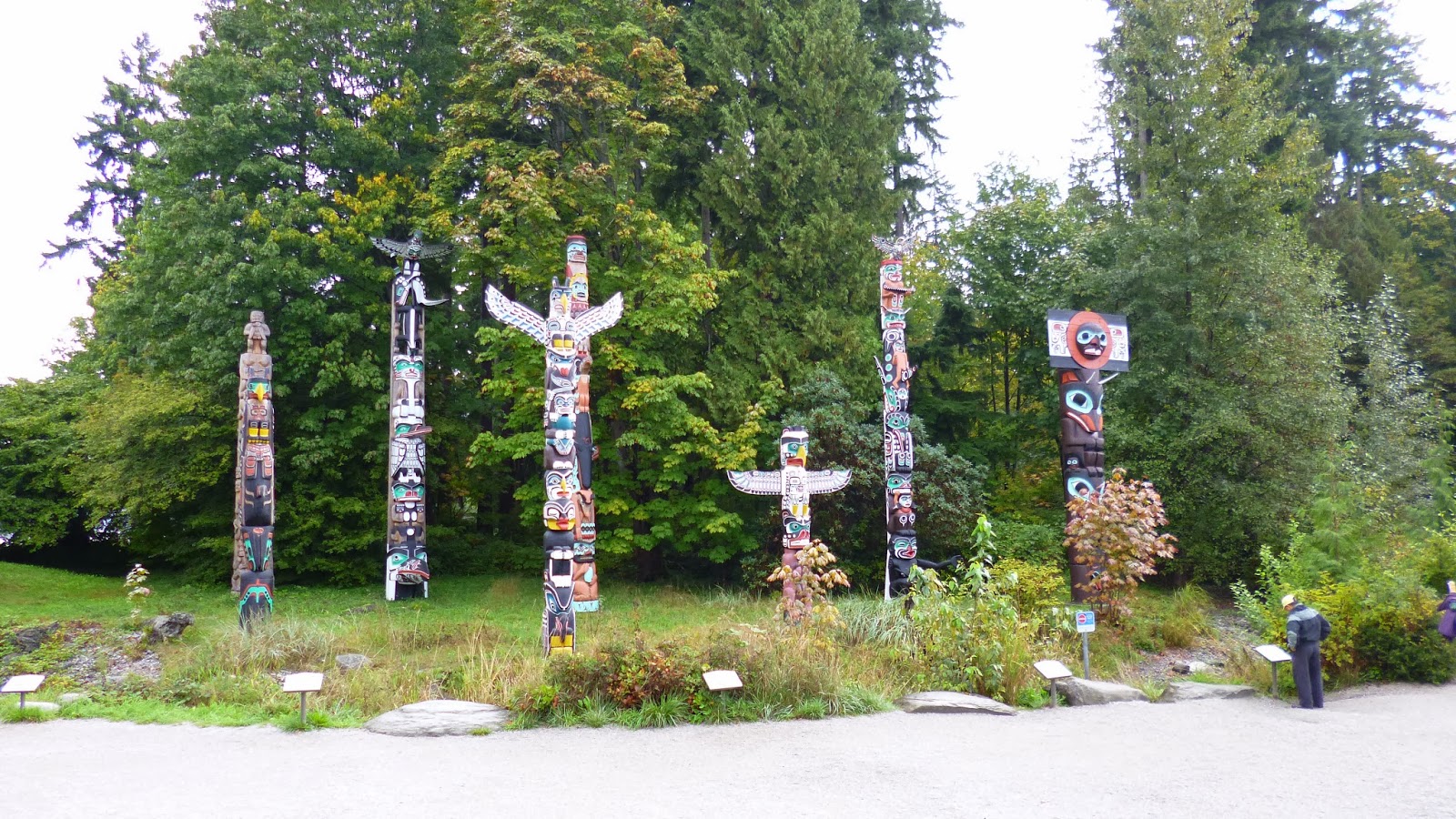
We walked around the park taking in the beauty then moved on to Brockton Point to see the First Nation's Totems.

The view beyond one of the huge gateways to the park.


Lions Gate Bridge in the distance

The Girl in the Wetsuit -although some believe it was a replicate of Copenhagen's The Little Mermaid, the  creator stated:   I didn't believe we should have a copy of the mermaid. She is rightfully a symbol of Copenhagen... I proposed to have a life-size scuba diver seated there. At that time scuba diving was getting quite popular here in Vancouver and, just as important, I didn't know of any similar sculpture anywhere in the world, it was a new idea.


On our way through the park to Prospect Point and Lowden's Lookout this 600 year old Cedar tree was pointed out to us.

That wasn't the oldest tree we saw though, this next one was 1000 years old and had been hollowed out by lightening!
We arrived at Prospect Point, the highest point in Stanley Park.  Lowden's Lookout was originally the site of a signal station, which guided ships through First Narrows, the views were magnificent,


as was the flora.


We got a closer look at Lions Gate Bridge, opened in 1938, officially known as the First Narrows Bridge, it is a suspension bridge that crosses the first narrows of Burrard Inlet and connects the City of Vancouver to the North Shore municipalities of the District of North Vancouver, the City of North Vancouver and West Vancouver. The term "Lions Gate" refers to The Lions, a pair of mountain peaks north of Vancouver. Northbound traffic on the bridge heads in their general direction.
If you click on the photo you should be able to see the stone lions on either side of the bridge.  Leaving Stanley Park behind we headed back into the city passing BC Place Stadium,

Chinatown,
then we were taken to Dr Sun Yat Sen Park.

Built in 1985-1986. The outer park was designed by architects Joe Wai and Donal Vaughan, while the inner garden was conceived by Wang Zu-Xin as the chief architect, with the help of experts from the Landscape Architecture Company of Suzhou, China. Funding for the project came from the Chinese and Canadian governments, the local Chinese community, and other public and private sector sources, and it opened on April 24, 1986, in time for Expo 86.  


It is an oasis of calm in a busy city and I could have stayed there all day, however we had to return to our coach to be taken to the next place on the tour, historic Gastown,
where we were dropped off to get some lunch and have the rest of the day to ourselves.    Gastown was Vancouver's first downtown core and is named after "Gassy" Jack Deighton, a Yorkshire seaman, steamboat captain and barkeep who arrived in 1867 to open the area's first Saloon.


There was also this historical plaque

and a steam powered clock! 

Built to cover a steam grate, part of Vancouver's distributed steam-heating system, the clock was built as a way to harness the steam and to prevent street people from sleeping on the spot in cold weather. Its original design was faulty and it had to be powered by electricity after a breakdown. The steam mechanism was completely restored with the financial support of local businesses as it had become a major tourist attraction, and is promoted as a heritage feature although it is of modern invention. The steam used is low pressure downtown-wide steam heating network (from a plant adjacent to the Georgia Viaduct) that powers a miniature steam engine in its base, in turn driving a chain lift. The chain lift moves steel balls upward, where they are unloaded and roll to a descending chain. The weight of the balls on the descending chain drives a conventional pendulum clock escapement, geared to the hands on the four faces. The steam also powers the clock's sound production as Whistles used instead of bells to produce the Westminster "chime" and to signal the time.

After lunch in one of the many pubs/restaurants/bars we made our way to Harbour Centre. I'm not very good with heights but agreed to go up in with MWM as it promised spectacular views of the city.   The Vancouver Lookout located atop the Harbour Centre business building, was officially opened on August 13, 1977 by Neil Armstrong, whose footprint was imprinted onto cement and was on display on the viewing/observation deck until it was lost (or stolen) during renovations. Glass elevators whisk visitors 168 meters (553 feet) skyward from street level to the Observation Deck in 40 seconds, you can see them in the video below which we took before going in.  Before you ask, the beeping you can hear is the sound of the pedestrian crossing where we were standing to take the video.


The views are magnificent, though I tried not to look down and left the filming to MWM.


After all that excitement we called in a Costa for a coffee before heading back to our hotel for a short rest before freshening up to go out to eat.    We didn't want to go to far so we did a quick search online and found a restaurant/bar nearby with a decent menu where we didn't need to book.    When we arrived at the bar we were told it was $10 each to come in as they were showing live cage fighting on the big screens!   We told them we only wanted to eat and have a few drinks and promised not to the watch the TV and they let us in.   Once inside we understood why they were charging people to come in because a lot of people were neither eating or drinking, they were just watching the screens.    Anyway we enjoyed our food and a few beers and (don't tell them) the cage fighting!  LOL

I hope you'll join me for Canada Part 7 when we go to Victoria, Vancouver Island, for a two night stay.

Tuesday, 14 January 2014

Canada Part 5.....

Sorry to those who couldn't see anything I mistakenly published before I'd actually written anything!   Anyway here it is now. 

Day two of our Rocky Mountaineer trip dawned and the coaches were waiting to take us to the station.  However there were another eleven carriages to add to our train, which had arrived in Kamloops from Jasper, making it 26 carriages long.

Our stewards from the previous day were waiting to greet us as we boarded our carriage to take the same seats we had vacated the day before.    Before too long we were underway and breakfast was being served for those who had been on the second meal sitting in the restaurant the day before, whilst those of us on second sitting were served fresh juice, tea/coffee and Danish pastries to tide us over until it was our turn to have the full monty.

The train headed out past Kamloops Lake


 and followed the Thompson River on the next leg of our journey.


As the train came through a tunnel we were told the amusing story of the owner of the farm at the side of the railway tracks.   Apparently the sound of the train's whistle, as it emerged from the tunnel, was disturbing his sheep, so he used to come out and start firing his gun at the train.   As this was highly dangerous he was taken to court and told not to fire his gun at the train again and the train is not allowed to blow the whistle. He obeyed the court ruling but in protest he regularly appears naked apart from his boots to passing trains.   We didn't see him!

If we thought our train was long we were amazed to see the freight train on the opposite side of the river, just look at this video.


We saw some teepees.

We were coming up to The Cisco Bridges, a pair of railroad bridges where the Canadian Pacific Railway and Canadian National Railway both follow the route of the Frazer River one on each side, and the routes exchange sides at this point. 

There was much excitement on the train as the drivers reported that something was about to happen that had never happened in the history of the Rocky Mountaineer and we should get our cameras ready. Another Rocky Mountaineer train was coming in the opposite direction to us and we were going to cross over at Cisco Crossing.    Luckily we managed to get a video of this momentous occasion, you will see us crossing on the top bridge as the other train crosses below.


Here's a shot of the other train on the other side of the river as we began the crossing,

 you can see the Gold Leaf carriages with the dome on top in the next photo,


 and here it is beneath us as we crossed over.


After all the excitement of 'the crossing' we settled back into our seats to watch for wildlife.   We saw lots of eagles and other birds but we all wanted to see another bear or some big horn sheep which were supposed to be prevalent in the area.   We had an agreement with our fellow passengers that whoever spotted wildlife would shout what it was and which side of the train it was on so we could all get a photo, suddenly I shouted "Chinook, on the left" which prompted cries of "where, where, what's a Chinook?"   LOL of course I was admonished when people realised I'd seen a Chinook helicopter, naughty of me I know but I just couldn't help it.

The next part of our journey took us over Hell's Gate an abrupt narrowing of the Fraser River where the towering rock walls of the Fraser River plunge toward each other forcing the waters through a passage only 35 metres (115 ft) wide.
 It is also the name of the rural locality at the same location.

 We shot some video of the raging waters going through Hell's Gate.


Oh I didn't mention the food did I? Just a little taster as I can't remember what we had and didn't take any other photos.It was just as scrumptious as Day 1.


The next shot is of Mount Baker (3,285m), a Glacial Volcano, which is actually across the border from Canada in the United States.   Mount Baker has the second-most thermally active crater in the Cascade Range after Mount Saint Helens, it is the youngest volcano in the Mount Baker volcanic field

Before we knew it we were on the outskirts of Vancouver.


We pulled into the station and our coaches were waiting to transfer us to the city and on to our hotel.

We went out to eat but weren't late in bed that night as we were shattered but spent some time looking at the photographs we had taken from the train on both days - lots, lots more than I've shared here.

We were looking forward to exploring Vancouver the following day, I hope you will join me for Canada Part 6 to share what we saw.