Day 8 another early start as we left Montreal behind on our way to Toronto, for a two night stay, via Ottowa.
Our first stop was Parliament Hill, Ottowa.
Parliament Hill colloquially known as The Hill, is an area of
Crown land on the southern banks of the
Ottawa River in Downtown Ottawa. Its Gothic revival suite of buildings serves as the home of the
Parliament of Canada
and contains a number of architectural elements of national symbolic
importance round the square.
Originally the site of a military base in the 18th and early 19th
centuries, development of the area into a governmental precinct began in
1859, after Queen Victoria chose Bytown as the
capital of the Province of Canada
.
Following a number of extensions to the parliament and departmental buildings and a fire in 1916 that destroyed the Centre Block, Parliament Hill took on its present form with the completion of the
Peace Tower
in 1927. Since 2002, an extensive $1 billion renovation and
rehabilitation project has been underway throughout all of the
precinct's buildings; work is not expected to be complete until after
2020.
After a whistle stop tour of Parliament Hill we were back on the coach heading for our destination for lunch - ByWard Market a district in
Lower Town, Ottowa,
located east of the government and business district, surrounding the
market buildings and open-air market on George, York, ByWard and
William Streets.
The market itself is Canada's oldest continuously operating farmers' market,
the market building is
open year-round, and open-air stalls are operated in the warmer months
offering fresh produce and flowers.
We didn't have a long stop over so we found a nice pub to have some lunch, the
Aulde Dubliner,
and very nice it was too.
We were back on the road again, with a short comfort stop, arriving in Toronto late evening. We checked into our hotel - here's the view from our bedroom,
unpacked the necessaries and went out to a local restaurant before retiring for the night.
A good night's sleep and a hearty breakfast ensured we were read for our tour of the city.
The history of Toronto began in the late 18th century when the British Crown
purchased its land, the settlement established became York, which
lieutenant governor John Graves Simcoe designated as the capital of Upper Canada. The city was ransacked in the Battle of York during the War of 1812. In 1834, York became a city and renamed to Toronto. Setting off on our tour of the city we found the different styles of architecture interesting.
Our first stop was Queens Park an urban park in downtown
Toronto. Opened in 1860 by Edward, Prince of Wales, it was named in honour of Queen Victoria
.
The park is the site of the
Ontario Legislative Building.
The building and the provincial government are both often referred to by the metonym "Queen's Park"
Designed by Richard A. Waite,
the Ontario Legislative Building is an asymmetrical, five storey structure built in the Richardsonian Romanesque style, with a load-bearing iron frame. MWM asked this rather tall policewoman if she minded us taking a photo, she kindly said yes.
We were driven round the affluent part of Toronto, Forest Hill, with it's beautiful properties,
passed
Casa Loma - (Spanish for
Hill House) a Gothic Revival style house and gardens in midtown Toronto, that is now a museum and landmark. It was originally a residence for financier Sir Henry Mill Pellatt.
Through Chinatown, where we saw the piece of art 'cat on yellow pole',
the oldest pub in Toronto, The Black Bull,
a car embedded in a wall.
We travelled down
Yonge Street, (pronounced "young street") Until 1999, the
Guinness Book of Records repeated the popular misconception that it was 1,896 km (1,178 mi)
long, and thus the longest street in the world; this was due to a mistaken conflation of Yonge Street with the rest of Ontario's Highway 11. Yonge Street is in actuality 56 kilometers long. Yonge Street has many different styles of artchitecture,
The unique
Brookfield Place an office complex comprising the 2.1 ha (5.2-acre) block bounded by Yonge Street, Wellington Street West, Bay Street, and Front Street. The complex contains office space and consists of two towers,
Bay Wellington Tower and
TD Canada Trust Tower, linked by the six-storey Allen Lambert Galleria. Brookfield Place is also the home of the
Hockey Hall of Fame.
inside Brookfield Place
outside Brookfield Place
We were back on the coach passing the
Steam Whistle Brewing Company
on route to the
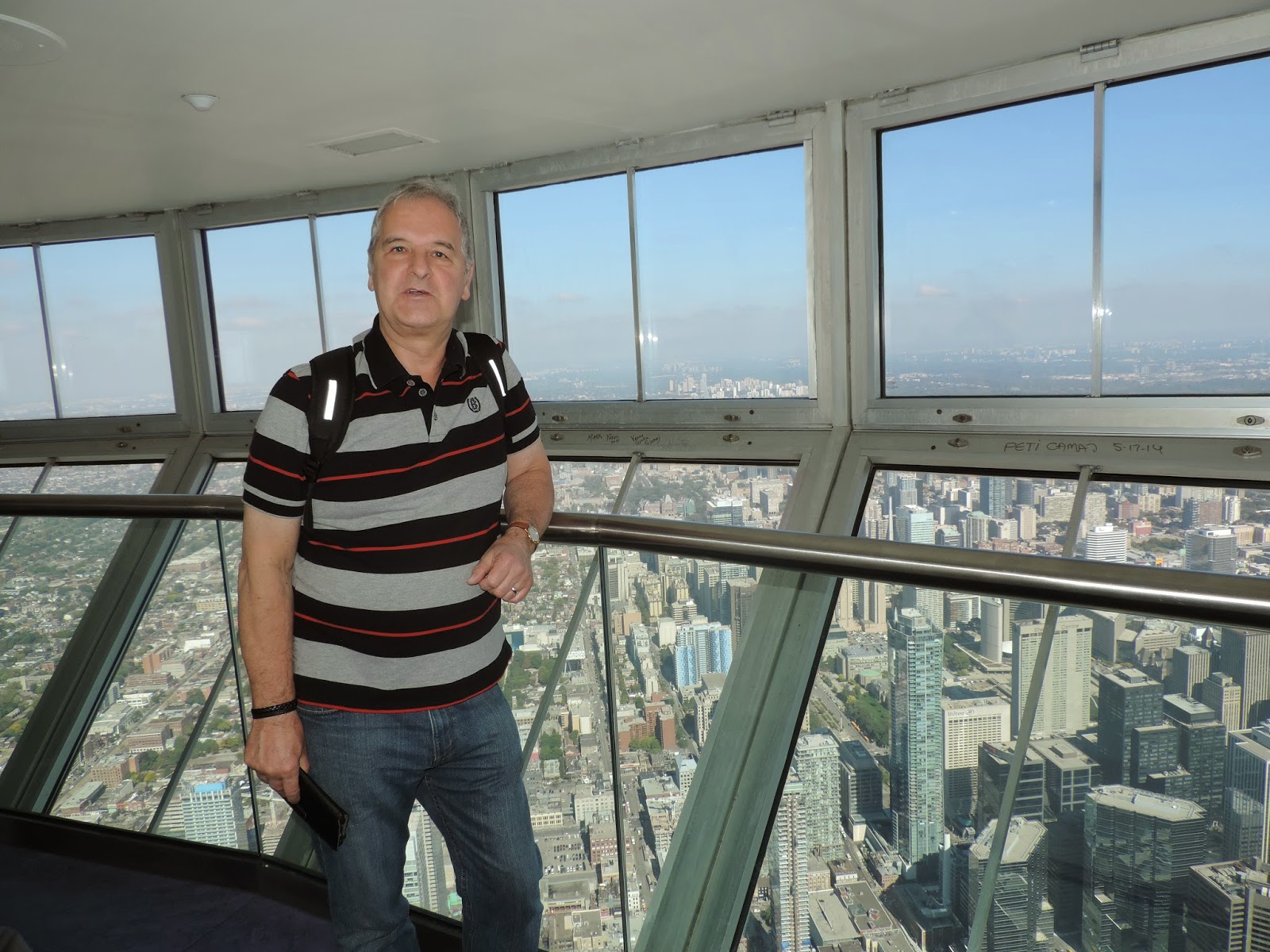
CN Tower
a 553.33 m-high (1,815.4 ft) concrete communications and observation tower.
The views from the main viewing level were magnificent
I even went on the glass floor
but then we went up further, to the pod, the highest observation point on the tower!
Did I tell you I don't like heights??
City tour over, those of us who wanted were taken back to our hotel, others stayed and continued sightseeing. We went back, grabbed a sandwich and a coffee from a nearby Subway and ate in our room, because we were meeting someone special at 2.30p.m. My old school friend Kaye, who I met when we started senior school together over 50 years ago has lived in Toronto for 30+ years, was coming to pick us up at the hotel to take us out of the city. We last saw her approximately three years ago when she was on a visit to England and she was thrilled to be able to meet up with us in her home city.
Kaye collected us in her car and took us to the beautiful
Rosetta McLain Gardens.
It was full of black squirrels!
We walked round enjoying the late flowers before getting in the car again so Kaye could take us to
Scarborough Bluffs,
(also known as
The Bluffs) are an escarpment in the Scarborough district of Toronto. The Bluffs have been described as a "geological wonder" and a unique feature in North America.
The Bluffs were named after Scarborough, England by Elizabeth Simcoe, the wife of John Graves Simcoe, the first lieutenant governor of Upper Canada. The bluffs along Scarborough's Lake Ontario shores reminded her of the limestone cliffs in Scarborough, North Yorkshire,
England. In her diary, she wrote, "The [eastern] shore is extremely
bold, and has the appearance of chalk cliffs, but I believe they are
only white sand. They appeared so well that we talked of building a
summer residence there and calling it Scarborough."
After a lovely afternoon of relaxing in the sunshine and catching up with our lives, Kaye took us back to her house in Scarborough to show us where she lives and made us a welcome cup of tea. After tea she took us to a nearby pub, The Black Dog, where we had their speciality dish Guinnes Steak and Kidney pie before she took us back to our hotel.
After a whirlwind tour of the city in the morning it was wonderful to catch up with a dear friend and see the countryside and suburbs of Toronto. A perfect end to our two days in Toronto.
Please join me in Part 8 when we leave Toronto for the journey to Niagara.